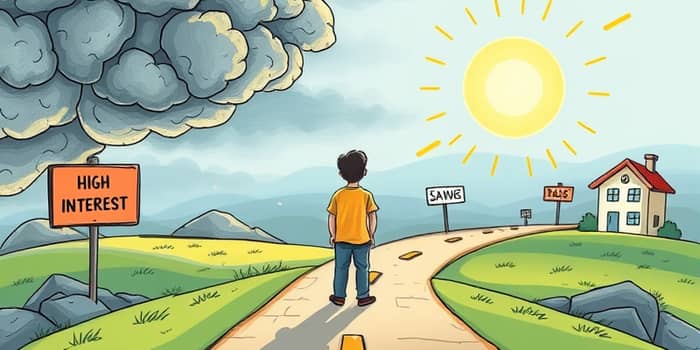
In moments of financial desperation, payday loans can seem like a lifeline.
They promise quick access to cash with minimal requirements.
However, this convenience often masks a perilous reality.
These short-term loans are designed to tide you over until your next paycheck.
Yet, they frequently lead to cycles of debt that are hard to escape.
This article aims to shed light on why payday loans should only be considered as a true last resort.
By understanding their mechanics and risks, you can make informed decisions.
We'll explore who uses them, the market trends, and safer alternatives.
Our goal is to empower you with knowledge and practical strategies.
At first glance, payday loans appear simple and accessible.
They typically range from $100 to $1,000, with a median of $350 to $375.
Borrowers are expected to repay the amount within a short term, often two weeks.
But the finance charges are steep, averaging $15 to $20 per $100 borrowed.
This translates to an astronomical annual percentage rate or APR.
For example, a $375 loan with a 15% charge results in an APR of 391%.
With a 20% charge, it skyrockets to 521% APR.
Such rates make payday loans one of the most expensive forms of credit available.
According to recent statistics, the typical borrower spends $520 to borrow just $375.
This high cost is compounded by state regulations that vary widely.
These caps are meant to protect consumers but often fall short.
The financial burden can quickly become overwhelming.
Payday loans are used by millions of Americans each year.
Approximately 12 million adults, or 1 in 20, turn to them annually.
Usage rates vary by state, from 1% to 13% of the population.
This highlights their prevalence in certain communities.
The demographic profile of payday loan borrowers is telling.
They are disproportionately individuals earning $40,000 or less per year.
African Americans, renters, and parents of minors are overrepresented.
Age groups between 25 and 44 are the most common users.
Many borrowers resort to payday loans for essential expenses.
Rent, utilities, and medical bills often drive this need.
This underscores the financial insecurity faced by many households.
Such patterns reveal a reliance on these loans for ongoing financial support.
It's a cycle that's difficult to break without intervention.
Despite the risks, the payday loan market continues to grow.
This growth is driven by factors like income inequality and financial stress.
Young adults, burdened by college debt, are increasingly aware of these options.
Here's a comparison of market projections from various sources:
This table shows consistent growth, even amid criticism.
Segments like online lending are expanding fastest, with a 4.2% CAGR.
Storefronts still lead in revenue due to physical access and quick approval.
Regionally, the US remains dominant, while Asia-Pacific sees the highest growth.
Drivers include job volatility and high living costs in many areas.
These trends indicate a market that thrives on financial desperation.
Understanding this can help you navigate it more cautiously.
Regulations play a crucial role in shaping the payday loan landscape.
States are categorized as permissive, hybrid, or restrictive based on their laws.
Permissive states have usage rates of 6.6%, while restrictive states see 2.9%.
This shows how policy impacts borrower behavior.
Reform efforts are ongoing, such as proposals for a 36% APR cap.
In Louisiana, for example, current APRs hover around 400%.
New rules aim to prevent evasion and protect consumers.
Trends include a shift toward installment loans and ability-to-repay checks.
Wage advance programs are emerging as more sustainable options.
These changes reflect a growing recognition of the predatory nature of some practices.
Staying informed about your state's regulations can help you avoid pitfalls.
Advocacy for stronger consumer protections is essential.
Payday loans are often marketed as emergency solutions.
In reality, they can create a vicious cycle of debt.
The high interest rates make it hard to repay the principal.
Borrowers may take out new loans to cover old ones.
This repeat borrowing fuels lender revenue but devastates finances.
Evidence shows that 75% of revenue comes from frequent borrowers.
This model relies on ongoing financial distress rather than one-time use.
The broader impacts extend to underserved communities.
Payday loans exacerbate struggles for those already facing economic challenges.
Alternatives like paycheck apps have emerged, but they carry similar risks.
Awareness of these risks is the first step toward protection.
Seeking help early can prevent deeper financial holes.
If payday loans are a last resort, what are the better options?
Several alternatives can provide relief without the same dangers.
Regulated small-dollar installment loans offer more manageable terms.
Earned-wage access programs allow you to access pay early.
Credit-builder loans help improve your credit score over time.
Digital underwriting and gamified repayment tools make these options accessible.
Financial literacy education is key to making informed choices.
Cover basic needs first, and avoid luxuries when in crisis.
Community resources, such as non-profits, often provide emergency assistance.
Building an emergency fund can buffer against unexpected expenses.
These steps empower you to take control of your finances.
Remember, patience and planning are better than quick fixes.
By prioritizing long-term stability, you can avoid the payday loan trap.
This journey requires effort, but the rewards are financial peace and security.
References