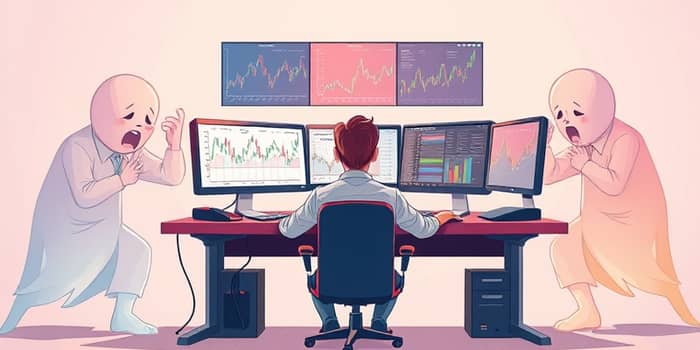
Imagine standing at the edge of a financial precipice, where every decision is laced with emotion.
Trading isn't just about numbers or charts; it's a emotional rollercoaster that tests your deepest instincts.
Mastering this mental game can be the difference between consistent success and devastating failure.
In fact, many experts argue that psychology is more critical than technical strategies for long-term prosperity.
This article will guide you through the psychological battles every trader faces.
You will learn to harness your mind for better outcomes.
Strategy provides the map, but psychology fuels the journey.
Neglecting mental discipline often leads to overtrading and poor risk management.
Traders who focus solely on techniques often flame out quickly under pressure.
The real edge lies in controlling your internal world amid external chaos.
Embrace this truth, and you unlock a powerful path to resilience.
Every trader encounters emotional traps that cloud judgment.
Recognizing these pitfalls is the first step toward overcoming them.
Here are some prevalent issues, supported by real-world experiences:
These biases explain market events like bubbles and panic selling.
Understanding them helps you stay grounded in volatile times.
Beyond emotions, cognitive biases distort our thinking in subtle ways.
Behavioral finance reveals how irrationality undermines logical decision-making.
Here is a table summarizing key biases and their impacts:
Mitigating these biases can boost performance by up to 30%, as studies show.
Awareness is your shield against these mental traps.
Building mental discipline requires actionable tools and habits.
Here are proven strategies to cultivate resilience and consistency.
Start with a solid trading plan to anchor your decisions.
Journaling is another powerful tool for self-reflection.
Daily habits foster clarity and reduce stress.
Mindset shifts are crucial for long-term growth.
These strategies transform psychology from a weakness into a strength.
Resilience isn't innate; it's built through deliberate effort.
Embrace the journey of self-improvement in trading.
Statistics show that journaling users exhibit better emotional control.
Loss aversion, where pain outweighs pleasure, can be managed with practice.
Focus on becoming a pro who reviews, reflects, and stays calm.
Contrast this with amateurs who react emotionally to market swings.
Incorporate these elements into your routine for steady progress.
Remember, you can't control the market, but you can control yourself.
This mindset shift is the cornerstone of sustainable success.
Winning the mental game requires patience and persistence.
By understanding biases and applying practical strategies, you gain an edge.
Trading psychology separates consistent traders from those who struggle.
Invest in your mind as much as your strategies.
Start today with a small step, like journaling or setting a trading plan.
Your future self will thank you for mastering this crucial aspect.
The path to trading mastery is paved with psychological insights.
Embrace it, and watch your confidence and results grow.
References